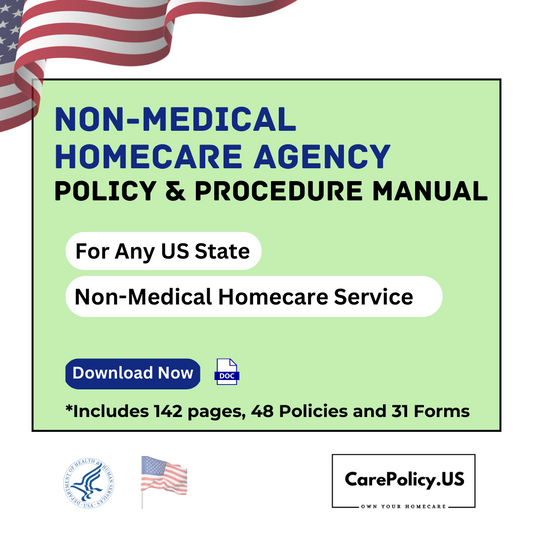
Starting or running a non-medical (private duty) home care agency in the United States means your documentation has to do two jobs at once: keep your day-to-day operations consistent and help you stay aligned with your state’s expectations for your provider type. CarePolicy supports agencies across all 50 U.S. states with an organized policies and procedures manual you can edit in DOCX and tailor to your services.

These templates are built for non-medical home care agencies offering services like companion care and personal care (as defined by each state). You’ll be able to customize language, insert your agency details, adjust workflows, and standardize training so caregivers and office staff follow the same playbook.

Browse non-medical home care policies & procedures templates

Choose your state requirements (A–Z State Finder)

Schedule a licensing consultation (sold separately).

State-Specific Non-Medical Home Care Policy and Procedure Manuals Collection

11 products

How CarePolicy helps non-medical home care agencies

Most agency owners don’t struggle because they “don’t have a policy.” They struggle because documentation is scattered, generic, or hard to implement. CarePolicy templates are designed to be:

  • Operational: written to match real agency workflows (intake, service planning, documentation, supervision, incidents).
  • Editable: provided in DOCX so you can customize terminology, services, and state-required language.
  • Organized: structured so your team can actually find and follow procedures consistently.
  • Practical for training: easier to tie to onboarding checklists, caregiver acknowledgements, and supervision routines.

What you get (DOCX templates designed for implementation)

CarePolicy non-medical home care documentation is delivered as a digital download in an editable format so you can tailor it to your agency. This is especially important if you operate in a state with specific terminology or required topics.

  • Format: Editable Microsoft Word DOCX
  • Delivery: Digital download (no hard copy)
  • Use: Customize, adopt internally, train staff, and maintain controlled versions

If you want help aligning your documentation to your state and implementing it with staff, you can add a separate licensing consultation.

What’s typically inside a non-medical home care policies and procedures manual

A complete non-medical home care manual usually includes both high-level policies (your standards) and step-by-step procedures (how staff carry them out). It often organizes content into administration, client care operations, staffing/training, and safety/quality processes.

Manual area What it helps you run Examples of topics
Agency administration How your business operates day to day Scope of services, roles and responsibilities, documentation standards, subcontracted services
Client care operations How clients move through your system Intake/admission, service planning, caregiver assignment, changes in services, discharge
Client rights & records How you protect clients and manage information Client rights, confidentiality, consent/authorizations, complaint handling, record retention
Personnel & training How you hire, onboard, train, and supervise staff Job descriptions, onboarding, training documentation, supervision, performance evaluation
Quality & safety How you prevent issues and respond when they happen Incident reporting, emergency preparedness basics, safety expectations, performance improvement routines

Many packages also include commonly used operational forms. The exact form set can vary by package, so review the included document list on the product/collection page before purchasing.

Key workflows your manual should cover

Non-medical home care is built on consistent execution. The strongest manuals focus on repeatable workflows that reduce confusion for caregivers and office staff.

Intake, admission, and discharge

  • How you handle inquiries, screen fit, and begin onboarding a new client
  • How you create a service plan and communicate expectations to caregivers
  • How you document changes in needs, schedule changes, and end-of-service

Service planning and caregiver documentation

  • Documentation expectations for tasks performed, observations, and exceptions
  • How you handle missed shifts, late arrivals, and coverage gaps
  • How supervisors review documentation and address issues early

Client rights, confidentiality, and complaints

  • How clients are informed of rights and how grievances are handled
  • How client information is protected and shared appropriately
  • How complaints are documented, escalated, and resolved

Staffing, training, and supervision

  • Hiring and onboarding steps that support consistent expectations
  • Training documentation and caregiver acknowledgements
  • Supervision cadence and performance evaluation routines

Incident response and safety expectations

  • What counts as an incident and how staff report it internally
  • Immediate response steps, documentation, and follow-up
  • Mandated reporting expectations where applicable, with an escalation pathway

Make it state-ready

Non-medical home care licensing categories and required topics can vary widely by state. The best approach is to start with documentation designed for your business model and then tailor it to your state’s terminology and required content.

Use the State Finder to select your state and review what applies to your provider type. CarePolicy also maintains state collections with state-specific information and resources.

If you want an additional checklist-based starting point, you can review: State checklist resources.

Note: Requirements and interpretations can change. Always confirm your provider type requirements with your state licensing authority.

How to roll it out with staff

To get real value from your manual, implement it like a system (not just a document). A simple rollout plan:

  1. Customize: update your agency name, services, terminology, and any state-specific language.
  2. Adopt: decide what’s “policy” versus “procedure,” and remove anything you won’t actually use.
  3. Train: tie key sections to onboarding and keep proof of training (acknowledgements and checklists).
  4. Audit: pick a few high-risk workflows (intake documentation, incidents, complaints, record handling) and confirm the manual matches reality.

Downloads, file types, and version control

Your documentation is only helpful if it stays current and consistent. Because these templates are editable, it’s important to keep version control:

  • Maintain a dated master DOCX file for edits
  • Publish a “staff copy” so caregivers aren’t working from outdated pages
  • Update your manual when services, staffing, or state requirements change

How to choose the right template package

Before you purchase a non-medical home care policies and procedures template, make sure it fits how you actually operate.

  • Non-medical focus: aligned to private duty/companion/personal care operations (not clinical home health documentation).
  • Operational coverage: includes intake, service planning, caregiver documentation, supervision, incidents, complaints, and records.
  • Editable DOCX: so you can adapt to your state and your workflow.
  • Clear next steps: you can train staff and implement consistently.

To see current pricing and available options, visit: Non-medical home care manual templates.

Available in all 50 U.S. states

CarePolicy is built for U.S. non-medical home care agencies. Since licensing categories and required policy topics can differ by state, the fastest way to get state-ready is to start with the correct business-model manual and then tailor it to your state’s terminology and required subjects.

Use the A–Z State Finder to select your state

FAQs

Is “home care policies and procedures” the same as non-medical home care?

Often, yes. Many people use “home care” to refer to non-medical private duty services. This page focuses on non-medical operations. If you provide skilled clinical home health services, your documentation needs can be different.

Can I use these templates in any state?

They’re designed to be customized. Because requirements vary by state and provider type, use the State Finder and confirm expectations with your state licensing authority.

Is the consultation included?

No. Consultation is a separate service. If you want guided help tailoring documentation to your state and rolling it out with staff, you can schedule a licensing consultation.

Do these packages include forms?

Many packages include commonly used forms for intake, service planning, incidents, training acknowledgements, and documentation workflows. The exact forms included can vary, so review the included document list on the product/collection page before purchasing.

Do I need policies and procedures before applying for a license?

Many states require documentation during licensing or early operations, but the specifics vary. Preparing your manual early—and tailoring it to your state—helps you avoid delays and confusion during setup.

Is this for U.S. non-medical home care agencies?

Yes. CarePolicy supports non-medical home care agencies across all 50 U.S. states. Since requirements vary by state and provider type, use the State Finder to align your manual to your location.

Collapsible row

Next steps

If you’re ready to move forward:

  1. Choose your state in the A–Z State Finder.
  2. Browse state-specific packages to match your provider type: State-specific templates.

Schedule a licensing consultation if you want guided support (sold separately).